How to Change Careers in Your 40s Without Starting Over

Your 40s can be weird - you’ve accumulated a lot of life experience but you still have no clue what you’re doing. You’ve worked for over half your life, maybe even have an established career in a field that once mattered to you, and now you’re wondering if you’ve been doing the wrong thing the whole time. If you’re anything like me, you’ve realized you want to make a change but are terrified to leave the comfort and safety of the career you’ve established.
You’re in your 40s, and you’re not interested in starting over, working your way up to a decent paycheck again. But something isn’t quite right. Your relationship to work has shifted. Maybe you used to have a lot of ambition and drive and now you just want a job that lets you actually sign off at the end of the day. Or maybe you picked a job that lined up with your ideals, and now you’re tired of being paid peanuts. You want to have enough money to travel. To actually retire someday.
You’re in good company. Research on career changes indicates that the average age for career pivots is 39. One of my favorite newsletter writers, Anne Helen Petersen, did a post on mid-life changes that I’m still thinking about three years later. You should read the comments - you’ll find a lot of people like you out there.
For me, the breaking point was realizing that my cushy tech job was quickly becoming, “Let’s use AI to replace all the meaningful creative work that our humans do, and then we won’t have to hire so many humans.” (Damn humans, always wanting things like a living wage and health insurance.) I felt sick going into work every day.
Isn’t a ‘career pivot’ just code for starting from the bottom?
I get this worry - I really do. Here’s the thing: when you decide you’re ready for a change, the part of you that DOES NOT WANT you to change is going to come online and start telling you all kinds of scary, wild stories to keep you stuck. I can’t try something new - I’ll have to start from the beginning (and I am too old for that shit). I can’t make that career leap - I have this limited set of skills and no one will hire me. The job market is terrible - now isn’t the time to make a change. Yeah, my current job is killing my soul little by little, but I like my coworkers. I get to work remotely on Fridays. It’s not so bad.
These are all stories. More specifically, they are stories intended to diminish you, to keep you small. If you stay small, the reasoning goes, you stay safe. You can’t be judged. You can’t be seen trying and (possibly) failing.
They’re also stories shaped by our current late-stage capitalist hellscape. Workplaces benefit from employees who think their skills could never transfer anywhere else. Makes it easy to pay you less. The tech overlords want you too burned out to get mad about the deeply inequitable world they’ve created for us. And in the US, tying health insurance to employment and wrapping our retirement up in the stock market are spectacular ways to make people feel like they’ve got so few options.
But I am here to tell you that you have more options than you can see right now. It may feel like “stay in the same career forever” or “start over in an entry-level job” are the only two options, but they aren’t.
Madeleine L’Engle once said, “The great thing about getting older is that you don’t lose all the other ages you’ve been.” (Any other A Wrinkle in Time fans out there?) This is the perspective I want you to hold when you’re considering trying something new in your career: I may be new to this job, but I am not new to work. I still get to carry with me all the experience I’ve gained over the course of my career.
No matter how big your career pivot, you are not starting from nothing. You just need to know what you’re taking with you from one career to the next. (That’s what a good career coach is for.)
Okay, but where do I even begin with making a career change?
Well, you’re reading this blog post, so you’re already getting started. You’re letting yourself imagine that something else is possible. That’s incredible. I mean that with all my heart. Giving yourself permission to dream is one of the most beautiful gifts you can give yourself.
But let’s get tactical. How does change happen?
Step 1: Let yourself want to change.
Acknowledge that you’re dissatisfied with your current career. Own that you want something different. Write in your journal. Tell someone about this. There’s power in not keeping this desire locked up. Who’s got your back? Tell them that something has shifted for you.
Step 2: Don’t think you’ve got to do this on your own.
This one’s for all my hyper-independent, eldest daughters. I am one of you. You probably keep your workplace running. If you keep doing everything on your own, you are buying a one-way ticket to Burnout Junction. Ask me how I know.
Help is available. I’m a career coach. This is literally my job, and I love it. If you’re not ready for a professional, turn to your support system. They want to be there for you during this transition. I promise. (Don’t have a support system? I am going to gently encourage you to consider that this may be your work right now. There’s a lot that can feel hopeless when you don’t have anyone to lean on. Also, coaches and therapists are a good place to start. We are a judgment-free zone.)
Step 3: Get to know the part of you that keeps you small.
Maybe it’s imposter syndrome. Maybe it’s your inner critic. Whatever you call it, we all have a part of us that is resistant to change. This part of you is going to get in your way at every turn when you decide to make a career pivot.
The key? Remember that this part of you is not a problem. I’m serious. This part of you has a job - to keep you safe, often from other people’s judgment. And she* has done a great job for a long time. People know you are smart and capable and dependable because this part keeps showing up. Thank her. Validate her. And tell her you got this.
You’re going to have this conversation with her many, many times. That’s okay.
*insert whatever pronoun fits
Step 4: Get clear on what you want
If your immediate response is “I have no clue what I want,” I got you. It’s okay to start with broad strokes. For example:
I know that I’m not willing to move.
I know that I need a job with flexible hours.
I know that I have to make at least $xx,xxx.
I know that I never want to see the inside of a cubicle ever again.
Make your list. Then let’s play a fun little game. I call it: The Job from Hell.
Write a description of the worst possible job you can imagine. Get specific. Where do you work? Who do you work with? Are you in management? What does your typical day look like? Meetings? Spreadsheets? Fundraising? How much structure do you have? How much autonomy? Mine your past jobs for inspiration on everything you hate about work.
Take a look at your description. What patterns are you noticing? What has this exercise clarified for you?
Step 5: Define one step you can take right now.
This does not need to be a big step. You may not have enough clarity yet for big steps. You may still be wrestling with your self-doubt. Move at your own pace. Some possible next steps:
Set a job search with the parameters you’ve laid out (e.g., remote, pay, industry).
Connect with someone you know who’s doing work you find interesting.
Make a list of your current skills. What do you have to offer?
Step 6: Repeat steps 1-5 as needed.
Change doesn’t happen overnight. Clarity takes time. Give yourself that time. There is no deadline. (Urgency is just another lie capitalism has sold us.)
Using tarot to make a career pivot
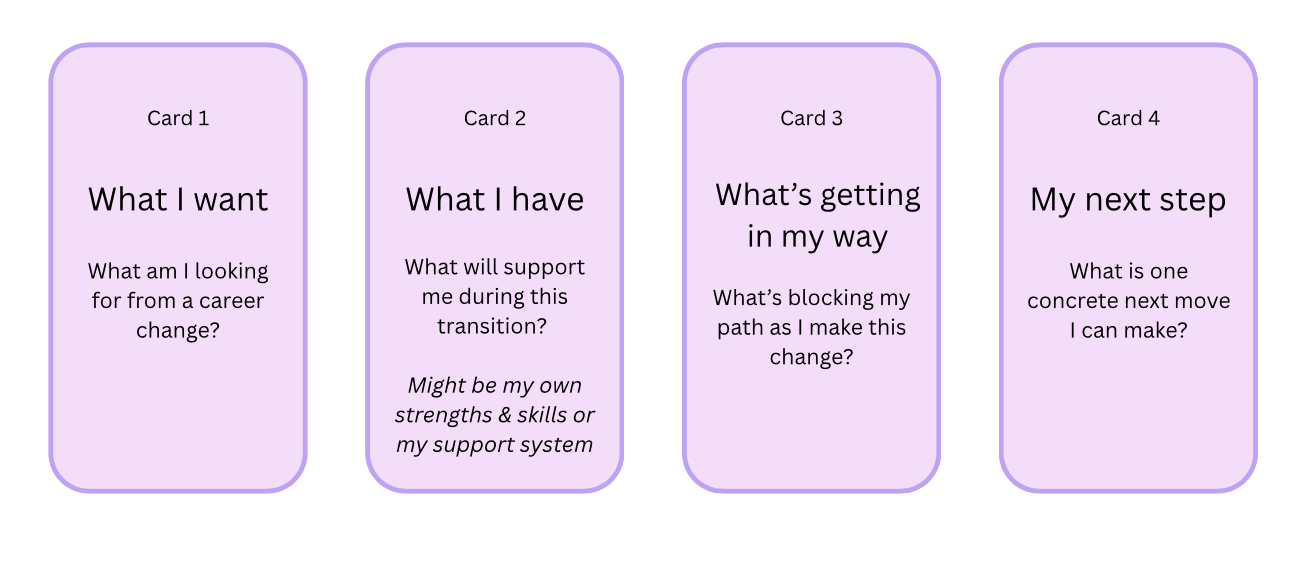
I use tarot cards in my career coaching practice. Tarot is a great tool for self-reflection, and you can weave it into all the steps I recommended above. If you’re curious, get a deck and try this simple spread out.
Tarot spread for making a career pivot: